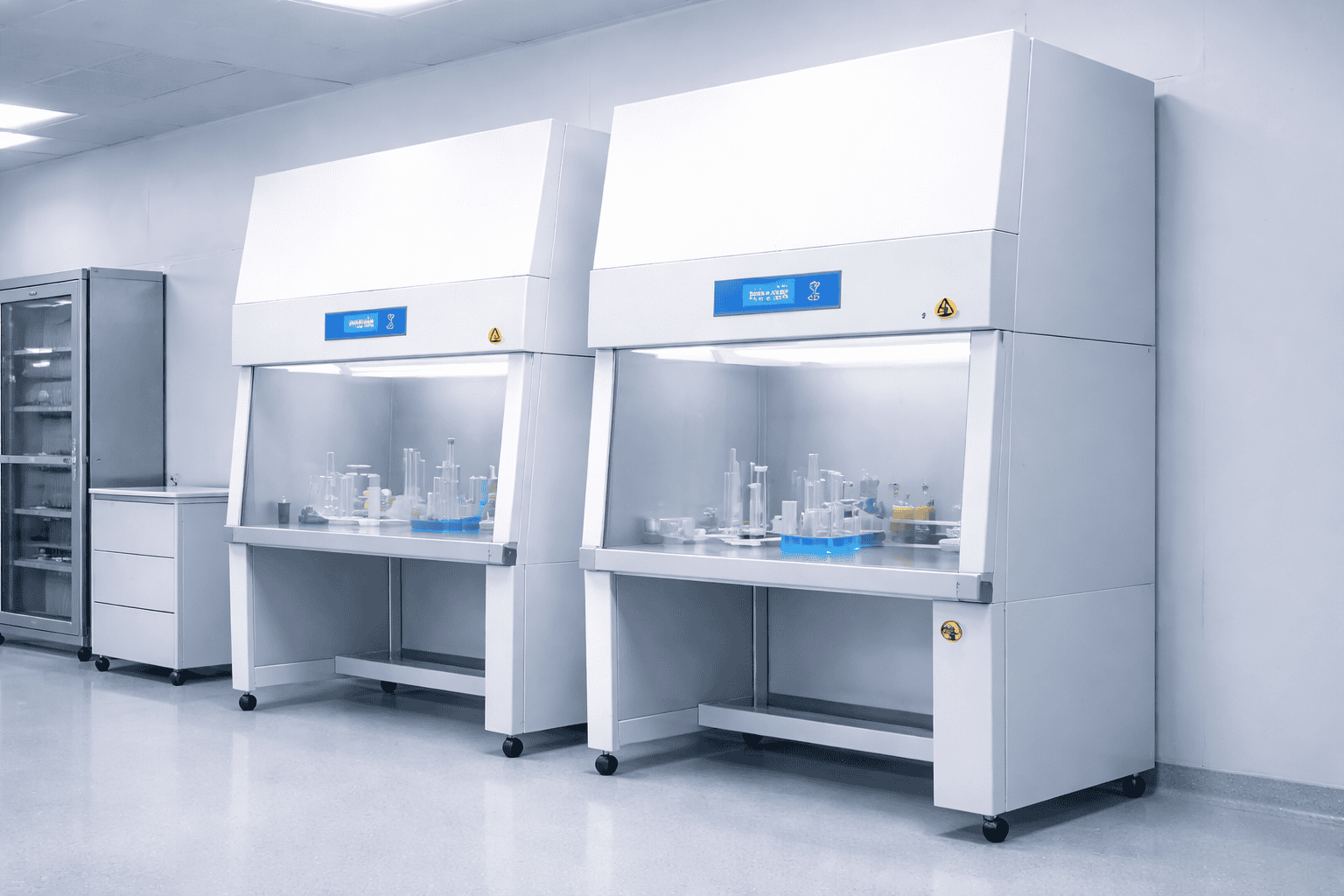
“Hygiene Flow Systems” Biosafety cabinets are used as the primary means of containment for working safely with infectious microorganisms. However, biosafety cabinets are only one part of an overall biosafety program, which requires consistent use of good microbiological practices.
Biosafety cabinets are designed to prevent biological exposure to personnel and the environment and may also protect experimental material from being contaminated when appropriate practices and procedures are followed. Three kinds of biosafety cabinets, designated as Class I, II and III have been developed to meet varying research and clinical needs.
| Construction Material | Powder-coated steel or Stainless Steel (SS 304/316). |
| Cleanliness Level | ISO Class 5 (Class 100). |
| Filtration | H14 HEPA filters, 99.99% to 99.9995% efficient at 0.3 µm particles. |
| Doors | Materials are typically made of tempered safety glass or polycarbonate to ensure durability, visibility, and UV resistance. |
| Noise Level | Operating noise is generally between 60 ± 5 dBA, with modern designs prioritizing noise reduction for user comfort. |
| Control Panel | PLC with touchscreen or LED display. |
| Monitoring | Magnahelic gauge for monitoring pressure drop across filters. |
| Safety | Emergency stop buttons on Front sides. |
| Lighting | LED or fluorescent tube lighting. |
| Options | UV light, Ionizer, or HEPA-filtered ceilings. |
| Power Supply | 230 V AC, Single Phase. |
Class I Biosafety Cabinets :
Class II Biosafety Cabinets :
Class III Biosafety Cabinets :
A biological safety cabinet (BSC) is a primary engineering control used to protect personnel against biohazardous or infectious agents and to help maintain quality control of the material being worked with as it filters both the inflow and exhaust air.
Model: HFB900, HFB1200, HFB1500, HFB1800
Working Size: 3x2x2, 4x2x2, 5x2x2, 6x2x2
© 2026 Hygiene Flow Systems. All Right Reserved.
Designed & Developed by  Innov Touch Technologies Pvt Ltd.